Showing posts with label abolitionist. Show all posts

Thursday, February 16, 2017

Lucretia Mott

Lucretia Mott


I’m sure that some of you are familiar with Nantucket, Massachusetts. If not, it is a small beautiful island off of Cape Cod. A hot vacation spot, most recently, Kourtney Kardashian and her family vacationed there. Now imagine this serene little island over 200 years ago, inhabited by Quaker, women’s rights activist, religious reformer, and abolitionist, Lucretia Mott, formerly, Lucretia Coffin. This brave woman was born on January 3, 1793 in Nantucket, Massachusetts. 

By definition, a Quaker is, "a member of the Religious Society of Friends, a Christian movement founded by George Fox c. 1650 and devoted to peaceful principles. Central to the Quakers' belief is the doctrine of the “Inner Light,” or sense of Christ's direct working in the soul. This has led them to reject both formal ministry and all set forms of worship.”Mott’s parents influenced her Quaker upbringing which landed her at a Quaker boarding school in New York State at the age of thirteen. Upon working at the school as a teaching assistant, Lucretia met her husband, James Mott who greatly supported her religious beliefs and way of life.           

  Leaving Nantucket, and New York behind for Philadelphia becoming wed in 1811. Philadelphia suited their Quaker lifestyle very well, as the area was where William Penn influenced the area with Quaker beliefs. Mott became a Quaker minister in 1821. One of her strongest attributes being her articulate speaking abilities. 1827 brought the couple to chose a more progressive wing of faith. Her husband was so dedicated to Lucretia’s beliefs that he left the cotton trade around 1830. 

 Quakers were strong advocates against slavery and would boycott any products produced by slave labor. Mott’s “radical” views regarding slavery exposed her to several instances of violence. Mott helped found the Philadelphia Female Anti-Slavery Society in 1833, as their president. She took on an authoritative role in the national organization upon the admission of women. We have watched society succumb to racism, sexism, we have seen discrimination first hand. This time period would snicker at the thought of anyone other than a white male having equal rights, so one can only imagine the brutality Mott faced. She made tremendous strides, continuing on to when she was denied a seat in 1840 at the World Anti-Slavery Convention in London because she was a woman. Mott and Stanton arrived at the Convention where they were neither greeted nor were they acknowledged at all. The twelve Boston women who made this 3,000-mile trip were appalled and patiently waited to hear whether they could be admitted to the Convention. Almost all of these women were in their twenties, so it was inspiring to see such young and diverse faces standing up for slavery, and what would turn out to be the suffrage movement as well. At 11 o’clock that morning, the announcement finally surfaced that the women were excluded from the Conference, but if they still wanted to partake then they could sit behind a curtained wall and listen quietly. Mott did not let this deter her, instead she used her exemplary public speaking skills to preach outside. This visit to London sparked Mott’s friendship with Elizabeth Cady Stanton. After the Conference, Mott and Stanton walked with interlocked arms discussing their newfound dream of hosting their own Conference back in the U.S which they did. The Anti- Slavery Convention was the main starting point for the women’s suffrage movement. The summer of 1848, Mott and Stanton organized the meeting at Seneca Falls, New York. This was the starting point of Women’s Rights in America. Mott became president of the group in 1852.  

In 1850, Mott’s Discourse on Women was her life’s work, explaining her philosophy on women and feminism. One should high light one of the main points being that women’ roles in society were purely limited education, not innate inferiority. Mott advocated feminism in all forms, ranging from politics to economic opportunity and suffrage. Throughout Mott’s influential life, she was an amazing mother, wife, and home keeper. Five children and a husband is a job in and of itself, yet somehow this woman was able to do it all. 

Lucretia Mott. Elizabeth Cady Stanton, and Susan B. Anthony Monument.


Works Cited
"Module 04: How Did Abolitionism Lead to the Struggle for Women 's Rights?" Evidence Detail :: U.S. History. N.p., n.d. Web. 14 Feb. 2017.

History.com Staff. "Lucretia Mott." History.com. A&E Television Networks, 2009. Web. 14 Feb. 2017.

"Lucretia Mott." Biography.com. A&E Networks Television, 02 Apr. 2014. Web. 14 Feb. 2017.

Photos: Google Images

Tuesday, February 14, 2017

Susan B. Anthony and Elizabeth Cady Stanton

Ladies, the woman of our country have come a long way. Years ago, our rights and freedoms were greatly restricted, until two woman made a tremendous positive impact on US history, forever changing the rules and allowing us the freedom to vote, and giving woman the freedom to run for President of the United States.
But those were not the only significant changes that have taken place in somewhat recent history. Do you know why you now have the same rights as a man? Do you know why black women and white women both finally have the same rights? Well, you may not, and that is exactly why I’m here to explain the legacy of two truly remarkable, unstoppable women: Susan B. Anthony and Elizabeth Cady Stanton.
            Stanton and Anthony were two of the most influential people in United States history. Without these women, it is needless to say, that the world would just not be the way it is today, and that is a fact. Prior to the 1920’s, women had very limited rights with respect to many very important issues, such as the legal rights concerning a woman's body, her ability to vote, to work, as well as other, more simple rights and responsibilities of citizenship. Stanton and Anthony fought their entire lives to try and combat this discrimination and make these rights possible for all female US citizens.
            Stanton was the daughter of a wealthy mother, and a father who was a judge in the courts. Stanton's father had put all of his hopes and dreams into his children, especially his sons. Unfortunately, all of his sons ended up getting ill, and passing away, likely pushing Stanton so hard to make her father happy, but all he could say continuously to her was, “ I wish you were a boy.” That sentence replayed over and over in her head, as you can imagine, and influenced her thoughts and actions as she set out to become one of the  most notorious women's activist leaders in world history. This negative situation brought on by her father was transcended into a positive situation and only made Stanton hustle and bustle a bit more.[2] “Man cannot speak for her, because he has been educated to believe that she differs from him so materially that he cannot judge of her thoughts, feelings, and opinions by his own" (Stanton quoted  in ).[1]
Susan B. Anthony grew up a little bit differently, most notably because she had a father who had great morals at the time he raised her. He did not agree with the way the school system worked at all, and when he saw that his daughter could not practice long division with the boys, he yanked her out of grammar school, and sent her off to Philadelphia to get a proper education. Anthony, held her head high, and proudly went into teaching and leading the female department at the school she worked for. Anthony aspired to be a lot of things, but no way in heck was this woman going to get married, and tend to a man. Anthony was all about not being a “drudge ” and was determined to have equality.[2]  “The old idea that man was made for himself and woman for him, that he is the oak she the vine, he the head, she the heart, he the great conservator of wisdom, she of love, will be reverently laid aside with other long since exploded philosophy's of the ignorant past.” ( Quoted by Susan B. Anthony). [1]
            Anthony and Stanton met in 1851, in the midst of the women's rights convention. Word on the street, was that Anthony was eager to meet Stanton, because she had heard many positive things about the woman, including her passion for standing up for females of any color,all over. Anthony had thought Stanton had reminded her of herself, and was curiously admiring her works from afar. Fortunately, the two had come together, and were the most powerful duo of women the world has yet seen by leading the Women's Rights movement.  Anthony was convinced, that without Women being able to vote, equality was just something the world would never have the privilege of seeing, and therefore, women would not be granted the ability to live a safe, comfortable, equal life. The two went on to fight, lecture, and protest all over. The two even got to write and start the “Revolution” newspaper, which was all about women's suffrage movements.  The duo also went on to create and lead the National American Woman Suffrage Association. Stanton did all the public events, while Anthony did most of the behind the scenes work. The two women did pretty much everything they could to combat patriarchy, and more. In 1863, they were fortunate enough to win over the respect of male abolitionist republicans, which had formed “Women's Loyal National League” which paved the way for thousands of females to protest and prohibit slavery. In 1868, “The Revolution” went on to become a nationwide women's journal! [2 ]
                 Many achievements were completed, and Anthony fought so hard that she wound up getting arrested, but soon released. Despite the arrest, these accomplishments by both Stanton and Anthony were greatly recognized.  Anthony was said to have gone on to fight hard for women's rights, while Stanton at some point, had actually gone back home to be with her husband and six children.[2] Anthony had written many letters to Stanton, in midst of her dismissal. “Oh- How I do think of you & wish I had you here to help on the work-- Can’t you write at some point & send it on-- I can get all and more published than I can get-- Lovingly, yours-- “Susan B. Anthony. (95. The Selected Papers of Elizabeth Cady Stanton and Susan B. Anthony : An Awful Hush, 1895 to 1906)  [3]This letter and many more letters out there, led me to believe that Anthony was missing her partner in crime, Stanton. It seems as if though, Anthony was a little bit more introverted, and a fighter, while Stanton was at home tending to her children. It was said that Stanton, at times, lived vicariously through Anthony.  " My whole soul is in the works but my hands belong to my family" she said to Susan. (Judith Wellman-Biographer) [3 ] 
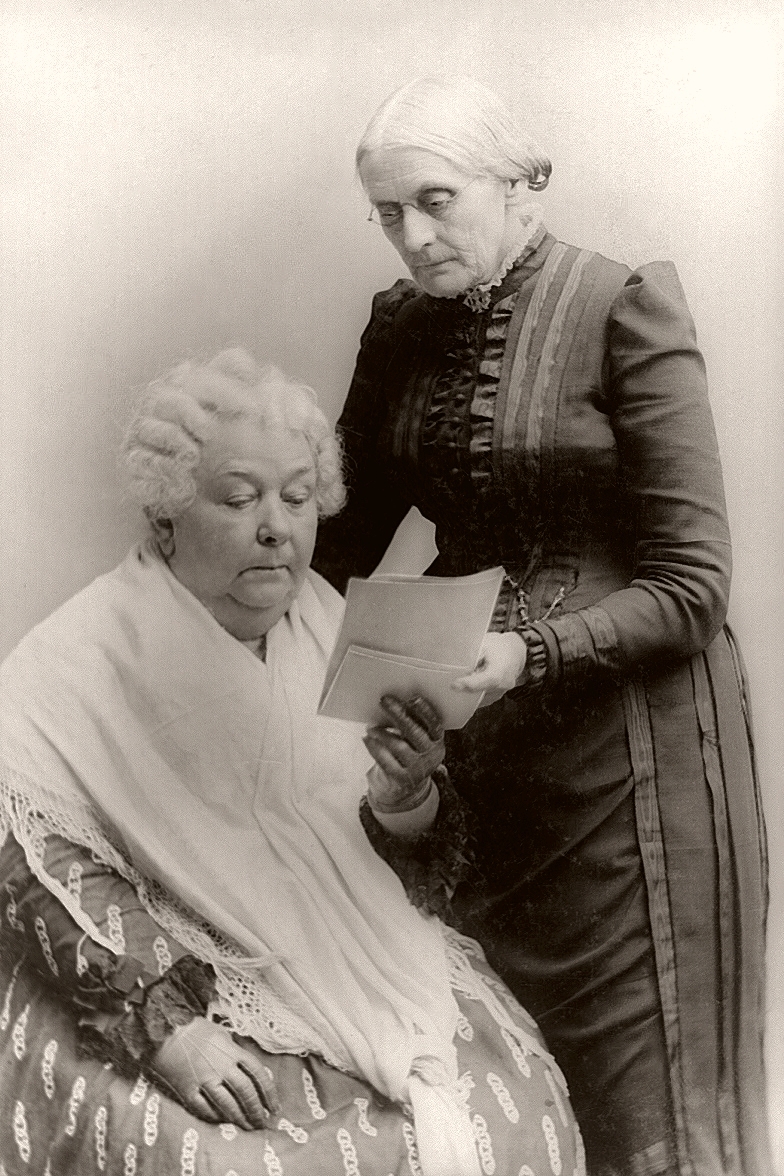
              The picture that I have put here of the two women, pretty much sums up their relationship. Anthony on the right, reading to Stanton and wearing glasses, and Stanton on the left, I assume is being taught something by Anthony. I guess it makes sense, because Stanton was the woman with the babies, and Anthony was the one more actively running around, trying to encourage and enforce change. The picture also shows the beauty of their friendship. It gives me comfort and pleasure  to imagine, that right here in this image, Anthony had come to Stanton's house to ask her advice on something she was about to publish in their newspaper, "The Revolution." Or, maybe Stanton was about to go on stage and speak, and they were both reading over some work they had formed together. Or maybe Anthony was telling Stanton she didn't agree with her works, and they were agreeing on something more suitable, or vice versa. Either way, no matter what the duo were doing in this photo, I'm sure it held great importance, since this remarkable photo is almost everywhere on the internet.
Figure 1: Elizabeth Cady Stanton (seated) and Susan B. Anthony (standing). Photograph by. Retrieved from: https://www.britannica.com/biography/Susan-B-Anthony 
Figure 2. "The Revolution Newspaper" published Jan 15th 1868 by Susan B. Anthony and Elizabeth Cady Stanton. Retrieved from https://upload.wikimedia.org/wikipedia/commons/thumb/5/54/The_Revolution_vol_1_number_2.png/440px-The_Revolution_vol_1_number_2.png
        
     After all the effort these two women put forth, after all the agony and protesting, one day at the last Women's suffrage Convention meeting, when it was apparent that the 19th amendment for women to vote would not be passed, Anthony fearlessly stood up, and stated, “Failure is Impossible.” It was not until much later that the The 19th amendment  was passed.  Bitter sweetly, it ended up passing  14 years after Anthony had been deceased, and 18 years after Stanton was deceased. Needless to say, these two admirable women kept the movement alive with their passion, long- loving friendship, and bad-ass work ethic! [2 ]
It excites me to state that Susan B. Anthony, and Elizabeth Cady Stanton, are the reason that us girls, AND BOYS, got to vote for Hilary Clinton  Clinton a few months ago, and that is a fact. Check out this fun video below! 


Figure 3: Video of Susan B. Anthony created by Dreamworks TV. Aug. 12, 2016. 


References:

.


[1] "Susan B. Anthony." Gay & Lesbian Biography, edited by Michael J. Tyrkus and Michael Bronski, St. James Press, 1997. Biography in Context, libraries.state.ma.us/login?gwurl=http://link.galegroup.com/apps/doc/K1634000014/BIC1?u=mlin_n_umass&xid=b241683d. Accessed 13 Feb. 2017.
[2] Ken Burns and Paul Barnes ; written by Geoffrey C. Ward ; produced by Paul Barnes, Ken Burns ; directed by Ken Burns. Not For Ourselves Alone : the Story of Elizabeth Cady Stanton & Susan B. Anthony. [Alexandria, Va.] : Hollywood, CA :PBS Home Video ; Distributed by Paramount Home Entertainment, 2004. Print.
[3] Bowers, Andy, and Katharine Lee. The Selected Papers of Elizabeth Cady Stanton and Susan B. Anthony: An Awful Hush, 1895 to 1906. Edited by Ann D. Gordon et al., Rutgers University Press, 2013, www.jstor.org/stable/j.ctt5hjfh1.

The Grimké Sisters

The Sisterhood: Shall women's voices be hushed?

It’s not a myth that throughout history women have been silenced when fighting for their rights as well as striving for equality. From the first female voice in congress[1], Jeannette Rankin to our own Senator Elizabeth Warren, a legacy of women, past and present time, did not just give up when experiencing times of gender oppression[2] and inequality -instead, they fought back with grace and wisdom. The sisters, Sarah Moore Grimké (1792–1873) and Angelina Emily Grimké (1805–1879) were both, literally and figurately, a great representation of this kind of sisterhood. In their sisterhood of inclusion, these sisters proved us what would happen when unifying our voices against hate, bigotry, and oppression, which led to great outcomes along the way.

Having a sister who would not only share your blood but also your ideas and passion, as well as encourage you to achieve your goals, is like finding a gold mine. The Grimké sisters were different in style but similar by heart. Daughters of a wealthy family in Charleston, South Carolina. Their parents were John Faucheraud Grimké, who was a lieutenant colonel in the Revolutionary War and speaker in the South Carolina House of Representatives before becoming the chief judge of the Supreme Court[3] of South Carolina, and Mary Smith, both plantation and slave owners.

In 1837, in our dear city of Lowell, Sarah and Angelina spoke against slavery in front of 1,500 people; although, they often were heavily criticized for “having the audacity to speak to promiscuous meetings of men and women together” (National Women's History Museum[4]).

The abolitionists and women’s rights advocates, Sarah, and Angelina Grimké has shown us that two voices are stronger than one. That having allies -just like a sisterhood- would be a better approach to gender and race inequality, while fighting for our rights and for those who cannot be heard -yet


🙋Facts About Sarah

“Our powers of mind have been crushed, as far as man could do it, our sense of morality has been impaired by his interpretation of our duties; but nowhere does God say that he made any distinction between us, as moral and intelligent beings


-Sarah Grimké. Letter III: The Pastoral Letter of the General Association of Congregational Ministers of Massachusetts. Haverhill, 1837
 
Sarah Moore Grimké 1792 to 1873. Image. Retrieved from the Library of Congress, <https://www.loc.gov/item/2003653378/>.


🎂 Birthday: November 26, 1792 (1873). 
  • Sarah was the sixth child and the second daughter out of the 14 brothers and sisters in total. She was 13 years older than Angelina.
  • In 1817, when Sarah was 26, her father was seriously ill. They moved to Philadelphia, where she served as his nurse. She also wasn’t the typical female for her era -her goals were to help women and slaves, even before thinking about marriage. She even turned down two marriage proposals![10] Nevertheless, her motherly side was reflected when helping to raise Angelina’s children just like she did in the past after taking responsibility of Angelina[11] when they were younger.
  • Sarah believed that education is the key[13] for preparing women for the equality, as she advocated for women’s educational and reproductive rights, their financial freedom, and claimed that women were in a position of slavery for being unable to refuse sex to her husband -what she called “legal prostitutes, a chattel personal, a tool that is used, a mere convenience”[14].
“Men seems to feel that Marriage gives him the control of Woman’s person just as the Law gives him the control of her property” (Sarah Grimké).

⚜ Sarah died on December 23, 1873; no information about the reasons was found.


🙋Facts about Angelina

“Will you behold unheeding, life's holiest feelings crushed, where woman's heart is bleeding, Shall woman's voice be hushed?" 
-Angelina Emily Grimké. Appeal to Christian Women of the South [15]. New York: American Anti-Slavery Society, 1836
Angelina Emily Grimké 1805 to 1879. Image. Retrieved from the Library of Congress, <https://www.loc.gov/item/2003653379/>.


🎂 Birthday: February 20, 1805 (1879).
  • In 1835, distressed by violent riots against abolitionists and African Americans in New York and Philadelphia, Angelina wrote a letter in response to William Lloyd Garrison who, without her consent, published her letter on The Liberator[18]. The letter led her into a storm in her hometown and with her family, especially among the Quaker society who openly condemned any radical activism[19] -they even wanted for her to retract the letter[20], but she kept her voice intact.
“Her writing drew the ire of southerners who opposed its abolitionist message and northerners who felt that women had no business writing or speaking about something as controversial as slavery (National Park Service[21]).
  • Angelina gave a one-hour speech in Philadelphia Hall[22] before a group that included around 3,000 women and men. During a time that women’s voices were social condemned if heard in public, especially about the issues on slavery and gender inequality, a mob attacked the building during Angelina’s speech; and the building was burned the next day. Fortunately, there were not victims reported.
  • At the age of 33, in 1838, she married Theodore Weld, an antislavery advocate[23] in the pre-Civil War period. A year later, Weld and the Grimké sisters published American slavery as it is: Testimony of a thousand witnesses, which was “designed to portray the horrors of American Slavery through a collection of first-hand testimonials and personal narratives from both freedmen and whites” (Monique Prince[24]).
  • Angelina gave birth of three children, Charles Stuart, Theodore, and Sarah -children whom her sister took care of them as the children she never had.

⚜ Angelina died on October 26, 1879, after been paralyzed for several years due to strokes.


📽🎞Videos 

“American Experience: The Abolitionists – Angelina Grimke.” American Experience PBS. YouTube. Published on Jan 7, 2013. https://www.youtube.com/watch?v=67Swj2usumY 


“Sarah Grimke & The Feminist Tradition: Shimer College Thought Series Lecture by Louise Knight.” Shimer College. YouTube. Published on Oct 22, 2015. https://www.youtube.com/watch?v=8fIsRBgKay4

👭👭👭👭👭👭👭👭👭👭👭👭


✎🖆Footnotes References


[1] “Jeannette Rankin.” History, Art & Archives. United States House of Representatives. February 2017. http://history.house.gov/People/Listing/R/RANKIN,-Jeannette-(R000055)/
[2] Min Kin, Seung. “Senate votes to shut up Elizabeth Warren.” Politico LLC. 2 Feb. 2017. http://www.politico.com/story/2017/02/elizabeth-warren-sessions-silence-234779
[3]  “Sarah Grimké (1792—1873) and Angelina Grimké Weld (1805—1879).” Internet Encyclopedia of Philosophy. February 2017. http://www.iep.utm.edu/grimke/
[4] T., Nadia. “Angelina (1805-1879) and Sarah Grimke (1792-1873)” National Women's History Museum. 2008. https://www.nwhm.org/online-exhibits/youngandbrave/asgrimke.html
[5]  Blundell, John. “Abolitionist Sisters.” Foundation for Economic Education. May 25, 2011. https://fee.org/articles/abolitionist-sisters/
[6] “Women Lawyers and State Bar Admission.” Law Library of Congress: American Memory. The Library of Congress. https://memory.loc.gov/ammem/awhhtml/awlaw3/women_lawyers.html
[7] Lerner, Gerda. The Feminist Thought of Sarah Grimké. Oxford University Press. p6. 1998.
[8] "Act Passed by the General Assembly of the State of North Carolina at the Session of 1830—1831" (Raleigh: 1831). Retrieved from: “Slaves Are Prohibited to Read and Write by Law.” History Is a Weapon. http://www.historyisaweapon.com/defcon1/slaveprohibit.html
[9] MacLean, Maggie. “Sarah Grimke.” History of American Women. 3 March 2013. http://www.womenhistoryblog.com/2013/03/sarah-grimke.html
[10] Knight, Louise W. “About the Grimké Sisters.” Louise W. Knight. http://www.louisewknight.com/about-the-grimke-sisters.html
[11] “People & Ideas: Angelina and Sarah Grimké.” God in America. WGBH Educational Foundation. 11 October 2006. http://www.pbs.org/godinamerica/people/angelina-grimke.html
[12] Board Moran, Karen. “Grimké Sisters.” Worcester Women's History Project. 2010.  http://www.wwhp.org/Resources/Slavery/grimkesisters.html
[13] Johnson Lewis, Jone. “Sarah Grimké: The mistaken notion of the inequality of the sexes.” Women’s History. About Inc. 28 November 2016. http://womenshistory.about.com/od/racialjustice/a/Sarah-Moore-Grimkandeacute.htm
[14] Lerner, Gerda. The Grimké Sisters from South Carolina: Pioneers for Women’s Rights and Abolition. New York: Oxford University Press. P.113. 1998.
[15] Rossi, Alice. The Feminist Papers: From Adams to de Beauvoir. Northeastern University Press; Reprint edition. p299. 1988.
[16] MacLean, Maggie. “Angelina Grimke.” 31 October 2013. History of American Women. http://www.womenhistoryblog.com/2013/10/angelina-grimke.html
[17] Berkin, Carol. “Angelina and Sarah Grimke: Abolitionists Sisters.” The Gilder Lehrman Institute of American History. 2016. https://www.gilderlehrman.org/history-by-era/slavery-and-anti-slavery/essays/angelina-and-sarah-grimke-abolitionist-sisters
[18] Berkin, Carol.
[19] “Angelina Grimké.” Libertarianism. 2017. https://www.libertarianism.org/people/angelina-grimke
[20] Perry, Carolyn. The History of Southern Women's Literature (Southern Literary Studies). LSU Press. 2002. p72-73.
[21] “Grimke Sisters.” Notable Women’s Rights Leaders. National Park Service. US Department of Interior. https://www.nps.gov/wori/learn/historyculture/grimke-sisters.htm
[22] Blundell, John. “Abolitionist Sisters.” Foundation for Economic Education. May 25, 2011. https://fee.org/articles/abolitionist-sisters/
[23] “American slavery as it is: Testimony of a thousand witnesses.” Archive.Org. February 2017. https://archive.org/details/americanslaverya1839weld2
[24] Prince, Monique. “Theodore Dwight Weld, 1803-1895.” Documenting the American South. The University of North Carolina at Chapel Hill. February 2017. http://docsouth.unc.edu/neh/weld/summary.html

Sojourner Truth


Take a moment to picture a broad-shouldered, six-foot-tall African-American woman, with deep-set brown eyes and high, prominent cheek bones. A woman with a disfigured hand from a childhood accident, whose voice is just as powerful as her silence. A woman who interrupted and challenged the famous abolitionist Frederick Douglass about his approach to combating racism at a conference in Boston[1]. A woman who despite never learning how to read or write, successfully became one of the most influential figures in American history. That woman was Sojourner Truth.

Sojourner Truth is the name Isabella Baumfree chose for herself in 1843. Before then, Isabella was a girl born into slavery to Dutch owners in New York sometime during the year 1797. Here she was sold from slave owner to slave owner throughout her childhood until she was eventually sold to James Dumont in 1810. Here she remained for sixteen years, bearing five children throughout that time period, until in 1826 when she escaped to freedom. Truth chose to escape because when the process of abolishing slavery was being initiated in New York, slaves were not expected to be emancipated until 1827. However, Dumont promised to give Truth her freedom a year early. Not long after, Dumont changed his mind and told Truth he would not free her early. Angered, Truth left four of her five children behind and fled, finding shelter from a Quaker family[2].

Sojourner Truth persevered through decades of slave labor, consistent abuse, and so much more. In 1815, Truth fell in love with a slave named Robert from a nearby farm. Their relationship was forbidden by Robert’s master. When Robert snuck out to meet Truth one night, he was caught by his owner and his owner’s son who brutally beat him. Robert later passed away as a result of the injuries[3]. Despite all she went through, including the loss of a loved one, Truth prevailed as a proud and self-assured woman. These hardships are what eventually leads her to recreate her identity by naming herself Sojourner Truth. This name reflects Truth’s belief that it was her mission from God to travel and speak the truth. Though sometimes met with hostility, Truth maintained her dedication to traveling and preaching about her beliefs. For this reason, Truth is remembered as a fierce, strong-willed woman who advocated for the rights of women and the rights of African-Americans. She fought for what she believed to be right and moral despite the consequences and the opposition she would face. The legacy she left behind depicts a feminist, an abolitionist, a powerful speaker, and a leader in the fight for human rights. Truth was and is a role model for many, as she demonstrated that it is possible to make your voice heard despite those who try to silence you and make you think you’re inferior. She is a symbol for speaking the truth even if you are standing alone. The impact that she left on this world, and that she left on the many people who followed in her footsteps, is often minimized and can go unnoticed, which is why it is so important to reflect on the life she lead.

Having never learned how to read or write, Truth was unable to leave behind any first-hand accounts of her work. The only records of her tremendous speeches and discussions are transcriptions written by white women, who have been revealed to twist the truth in their reports[4]. The authors of these transcriptions went as far as omitting parts of her speeches, depicting the crowd as hateful towards Truth when in reality they were not, and even describing Truth as speaking with a southern accent though Truth always lived in New York. Despite this, the information available about Truth gives insight to her revolutionary views and beliefs. Despite being held back by the inability to read or write, she persisted and continued to travel and spread the truth.

The speech Truth is most famous for is “Ain’t I a Woman?” which she presented at the Women’s Rights Convention in Akron, Ohio in 1851. In this riveting, unique speech, Truth probed why women are viewed as inferior to men. She declared that she is able to do as much work as a man: she could carry as much, mow as much, cut as much, eat as much. Truth challenged men, such as when she said, “You need not be afraid to give us our rights for fear we will take too much… The poor men seem to be all in confusion, and don’t know what to do.”[5] This forceful speech left an imprint on those who sat in the audience, who were in awe of Truth’s passion and strength. The unique perspective that she was able to give as an African-American woman and a former slave captivated those in attendance.  

Another event that Truth is most renowned for was when she won a court case against a white male in 1828, making her one of the first black women to have accomplished such a feat. This case was for the custody and freedom of her son Peter, who was illegally sold as a slave to another slave owner who abused him viciously[6]. This accomplishment, along with the many other experiences that Truth underwent since her escape from slavery led her to find God. This was the point in time where she made the decision to reestablish herself, and in 1843 she changed her name from Isabella to a name that she felt was more suitable, Sojourner Truth, which means “traveler.” She became a devoted Christian and began traveling and speaking about women’s rights and abolition.

Sojourner Truth’s life is one that was led by her perseverance and her dedication to what she felt that God was calling her to do. She dedicated her life, her experiences, and her wisdom to the human rights movement in an effort to ensure equality between genders and races. Truth resisted and fought oppression on all fronts for her whole entire life. The impact and progress she made for human rights has contributed to the point we are at today: where all races and genders are provided with education, where all races and genders are able to vote, and where great strides have been made to eradicate prejudice and racism from our society.   


Portrait of Sojourner Truth. Unknown Photographer.
Gladstone Collection. 1864.


[1] "This Far by Faith -Sojourner Truth." PBS. Ed. June Cross. PBS, 2003. Web. 11 Feb. 2017.
[2] Washington, Margaret. "Going 'Where They Dare Not Follow': Race, Religion, And Sojourner Truth's Early Interracial Reform." The Journal of African American History 1 (2013): 48. General OneFile. Web. 11 Feb. 2017.
[3] Gilbert, Olive, and Sojourner Truth. Narrative of Sojourner Truth. Champaign, Ill: Project Gutenberg, 2000. eBook Collection (EBSCOhost). Web. 11 Feb. 2017.
[4] “Sojourner Truth.” Available Means: An Anthology of Women’s Rhetoric(s). Eds. Joy Ritchie and Kate Ronald. U of Pittsburgh P, 2001. 143-46.
[5] Baym, Nina, and Robert S. Levine. The Norton anthology of American literature. 8th ed. New York: W.W. Norton & Company, 2013. Print.
[6] Washington, Margaret. "Going 'Where They Dare Not Follow': Race, Religion, And Sojourner Truth's Early Interracial Reform." The Journal of African American History 1 (2013): 48. General OneFile. Web. 11 Feb. 2017.